
Find A Partner Organization
K-5Clubs Appendices
All the appendices you need to run Project Heart in an after-school club, camp, or enrichment program — facilitation tips, games, guest speaker guides, project ideas, and planning tools, all in one place.
Appendix A — Facilitator Kit
Practical facilitation guidance for staff, guest speakers, and lesson leaders — how to make the lessons your own, involve student leaders, form groups, and connect philanthropy to real life.
General Facilitation Tips
- There are scripts of what to say throughout the lessons, and these are just suggestions for the staff, guest speaker or leader of the lesson. The more comfortable you become with philanthropy, the more likely you will be to put the ideas into your own words, making it a more authentic experience for you and the students.
- Look for the opportunities to involve student leaders. Invite kids often to speak to the whole group; a quick presentation to wrap up the day’s learning, teach a game, read the books aloud, explain something they’ve been learning, etc. This helps kids build empathy and the essential skills associated with design thinking and the entrepreneurial mindset.
- Several lessons involve writing (letters, thank you cards, charts for brainstorming, etc.). Don’t treat this like school, discourage stress over spelling. Ideally they will just do their best and not worry about it being perfect. A good strategy is to brainstorm words you might use ahead of time and write them on a “word bank” that is displayed. You can write words on a small white board for any kids who need their own word bank. If making posters, write out a draft on paper and have peer editors proof. With a larger group, consider two separate opportunities split by age and/or ability.
- Notes about partnering – you know your students best, so make partnering an inclusive element of any activity as appropriate. Strategies that work:
- Randomly count off.
- Intentionally pair up students who don’t normally work together, but haven’t exhibited animosity specifically toward each other.
- To encourage new pairings – tell students to get into partners, then find another pair to be a group of 4, then ask for a group of 6 (some of the 4s will have to break up), and then tell them to make 3 sets of partners where no one is in original pairs!
- In multi-age settings, think about pairing your youngest K-1 students with a 4-5 kid who can help them write if that is a barrier in an activity.
- If you don’t personally practice philanthropy yet, you’ll want to collect stories from friends so you can use real life examples and stories to connect to the lessons and the students. Here are some examples:
Needs & Services Examples
Need: Families can’t afford food
Service: county food banks and community cafés
Need: Neighbors experiencing homelessness
Service: local rescue missions and shelters
Need: Seniors & people with disabilities need rides
Service: volunteer driver programs for appointments
Need: Elderly neighbors feeling lonely
Service: senior center activities and visits
Need: Teachers short on prep time
Service: parent volunteers grade, laminate, and fill Friday folders
Need: Animals without homes
Service:90 Humane Society, animal rescues, ASPCA
Need: Sick kids separated from friends
Service: volunteers send cards, crafts, and stuffed animals
Need: Garden birds beat you to the harvest
Service: students build a scarecrow to protect the garden
Recommended Books
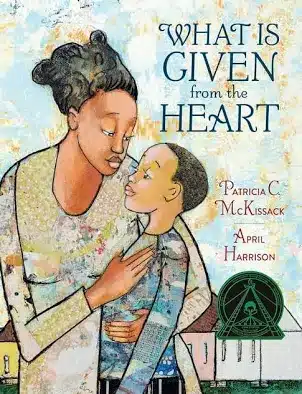
Pat McKissack & April Harrison · Schwartz & Wade, 2019 · Lexile AD660L · Reader level: 3.6
Beautiful story about a young boy who has to think hard about what to give a friend. He and his family don’t have much, but they still know how important it is to help another family who lost everything in a fire.
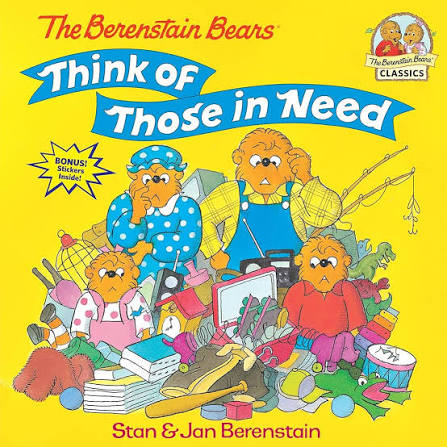
Berenstain Bears Think of Those in Need
Stan & Jan Berenstain · Random House, 1999 · ACCELERATED READER LEVEL 3.9; 2nd Grade Equivalent
Mama Bear realizes the family has too much stuff, so they find worthy organizations around town where their old stuff will have value again.
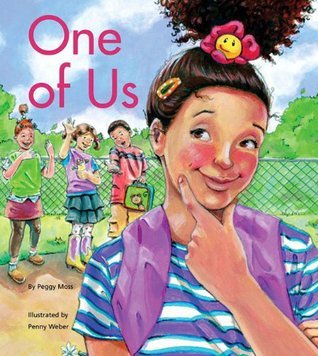
Peggy Moss & Penny Weber · Tilbury House, 2010 · Lexile: 350 · Ages 5–8
Roberta is new to her school, so she spends the day getting to know the other children to see where she fits in.
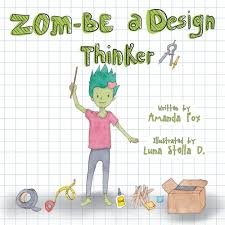
Amanda Fox & Luna D. Stella · Dave Burgess Consulting, 2019 · Guided Reading N · Lexile AD680L · Accelerated Reader Level 2.8
Zom-Be Zip teaches students design thinking – a process that uses your heart, brain, and hands to create. When you use your heart to empathize, think with your brain, and make with your hands, you turn Zom-Be Zip back into a real boy again. This book also works with the Artivive, Merge AR/VR, Metaverse, and CoSpacesEDU. Early Elementary and up.
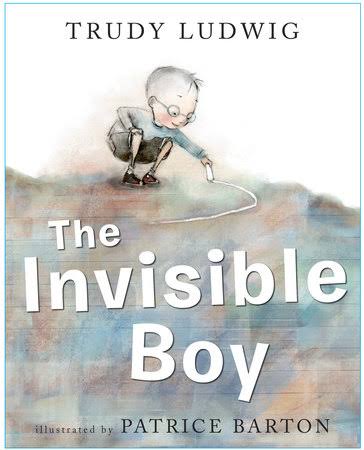
Trudy Ludwig & Patrice Barton · Knopf, 2013 · Lexile AD680L
Picture book about friendship and kindness. Great for empathy building, especially for younger students, questions for discussion at end.
Note for lesson 9
We chose The Invisible Boy because of its immediate impact on kids toward building empathy. Brian creates a note for the new kid, which moves the plot forward and connects to writing thank-you notes as a culmination for Project Heart. If you want to challenge upper elementary-aged kids, or would like to dive deeper into letter-writing skills, you may want to utilize a different story. Find good suggestions here.
Optional Books
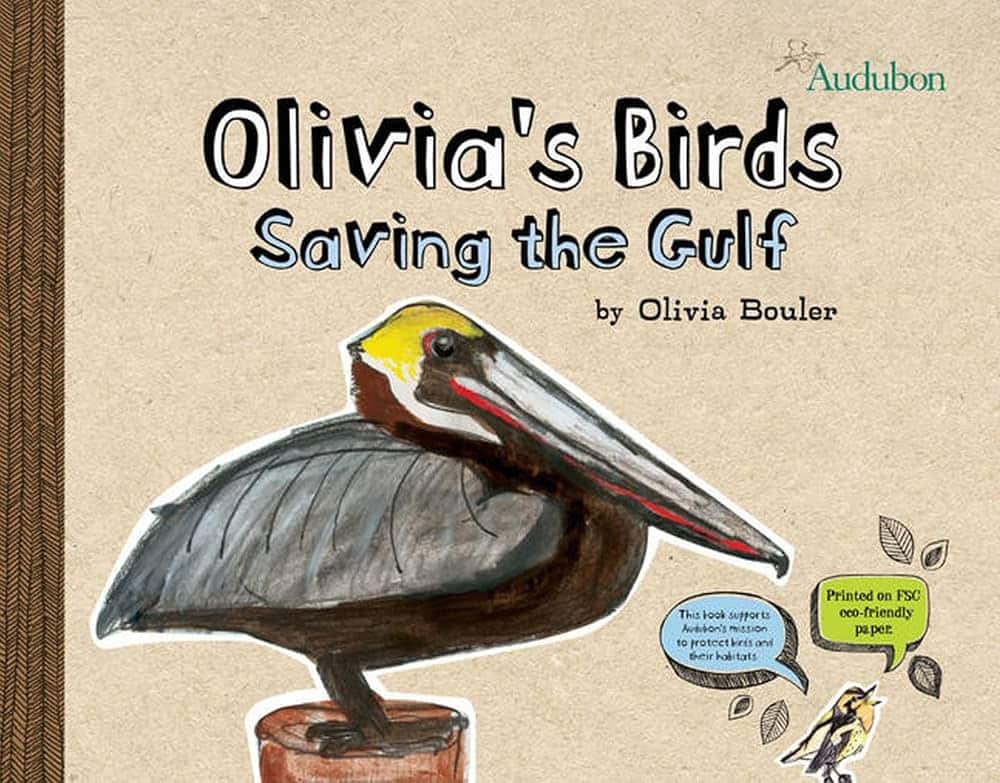
Olivia’s Birds: Saving the Gulf
Olivia Bouler · Sterling Children’s Books, 2011. · Lexile 880L · Accelerated Reader Level 5.1
This book is proof that students can make a difference! Learn facts about birds from an 11-year-old who raised over $150,000 using her time and talents.
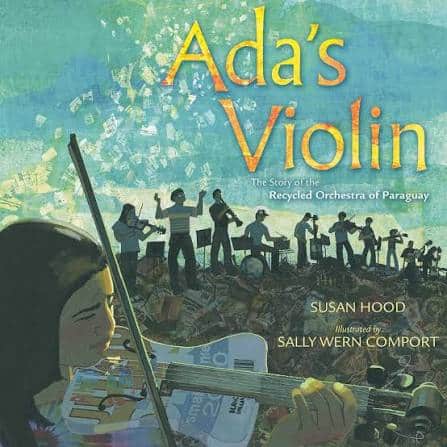
Ada’s Violin: the Story of the Recycled Orchestra of Paraguay.
Español: El violín de Ada: La historia de la Orquesta de Instrumentos Reciclados del Paraguay
Susan Hood and Sally Wern Comport · Simon & Schuster Books for Young Readers, 2016 · Lexile 820L · Accelerated Reader Level 4.6
This inspiring true story takes place in the poorest slum in South America. Aspiring child musicians use scraps from the landfill to build their orchestra and bring their music to the world.
OTHER MATERIALS
Appendix B — Games & Activities
Icebreakers, name games, team builders, and empathy-building activities to open sessions and bring the group together.
downloadable activity
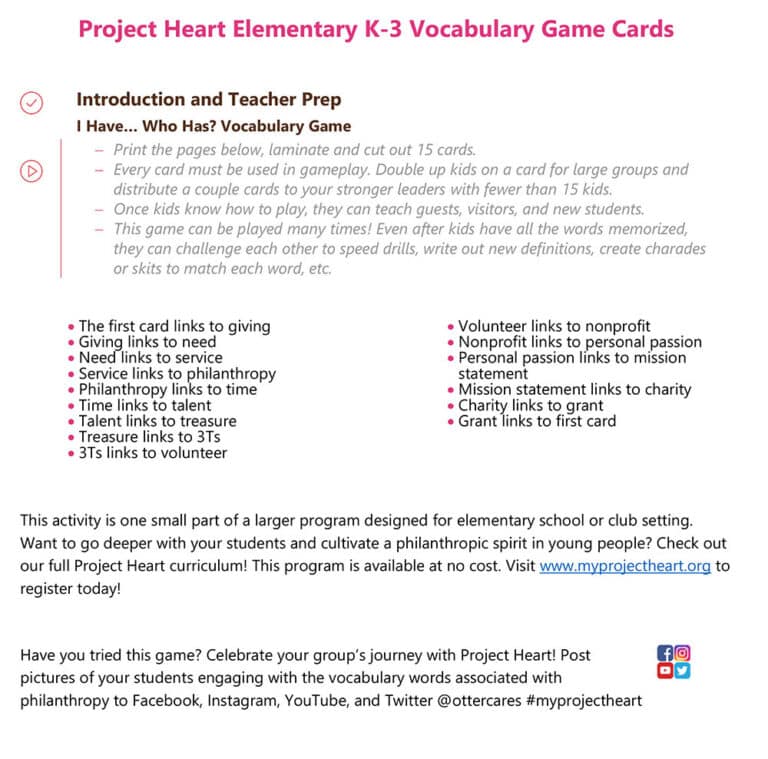
I Have… Who Has? Vocabulary Game
This activity helps students learn the vocabulary of philanthropy. Students use 15 cards to play a matching game to learn connections between words that describe the meaning and actions of philanthropy.
Icebreakers & Greeting Games
On the Bus or Off
ICEBREAKEREveryone stands in a straight line facing forward. The facilitator calls out two choices to a question, such as, “if you like vanilla stay on the bus, if you like chocolate, jump off the bus.” Participants would then decide and either stay where they are, or jump off the bus into a second line. You can continue to ask as many interesting questions as you like in this fashion: Sausage or pepperoni? Cats or dogs? Xbox or play station? Athletic sports or eSports? Knitting or Chess? Etc.
Telephone
ICEBREAKER EMPATHY BUILDINGOne person starts the games by whispering a message in the ear of the person next to them. If this person has difficulty understanding the message, they can ask that it be repeated by saying “operator.” The sender repeats the message and it is repeated all the way around. The last person then says the message they heard out loud. The group can then see how close they got to the actual message. Try using a funny message. And only allow someone to call the operator once.
Do This, Do That (Simon says)
ICEBREAKERThis game is the same as Simon says only a different name to make it faster and not “for babies”! The leader should say “do this” and do an action that can be copied. The leader should always say “do this” when they intend for the group to follow. When the leader is trying to stump the group, they can say “do that” anyone who does “that” is out. The faster this game goes the more fun it can be.
People to People
ICEBREAKER WITH CLOSE CONTACTHave everyone get a partner and stand with them in a loose circle. One person will be extra standing in the middle. They call out different combinations of body parts such as nose to shoulder, elbow to knee, back to forearm, foot to foot, etc. (all school/camp appropriate of course). When the caller says, “people to people,” everyone scrambles to find a new partner and the person left out is the new caller.
Sets
ICEBREAKERHave the kids sit down. Pick two or three kids that have something in common, such as stripes on their shirts, no shoelaces, or the same first letter in their name. Have them stand up. The rest of the kids try to figure out what makes them a “set.” Once kids get the hang of it, have them choose the next sets.
Connections
ICEBREAKER EMPATHY BUILDING(Everyone in the group needs an object to start – books, toys, shoes, stuffies, etc.) Each person should hold their object in hand as everyone starts to mingle. A pair of people must grab on to each other’s objects simultaneously until the pair finds something in common by asking questions of one another. Once a connection has been made, then each can let go of the other’s object while holding onto their original object and find a new partner to repeat the process.
Alike (20+ minutes)
ICEBREAKER EMPATHY BUILDINGHave everyone start with a partner; offer a sticky note or piece of paper and pen or pencil. Each pair will have about 5 minutes to come up with as many things in common as they can. Then have partners join another pair and the four of them have to come up with as many things in common as they can. Keep joining groups, repeating the same process, until you have 3 or 4 large groups; ask them again to find as many similarities as they can. Each group tells their similarities and the group with the most wins.
That Person Over There
NAME GAMEEveryone mingles to find someone to shake hands with and partners introduce themselves. Then everyone switches to a new person, but now they must introduce themselves plus the person before (by gesturing toward them and describing appearance). The game continues for about 5 minutes as partners continue to introduce themselves and everyone they have shaken hands with.
Finger Palm
TEAM BUILDERAsk everyone to form a circle (can create multiple circles or rows for large groups). Instruct them to hold their left palm up to the side and then point their right finger down to touch the palm of the person next to them. Everyone should now be supporting a pointer finger on their left palm and touching their right pointer finger to the palm on their right. The goal is to catch the person’s finger that’s in your left palm while trying to pull your right finger away before it’s caught. The leaders should tell the group to go on the count of 3. This can be played multiple times, just for fun or as a best 2 out of 3 competition. Be sure to mix up the pacing of counting to 3, and invite conversation with questions like, “how does it feel to have to keep track of two things at once? What happens if someone goes to early or too late? What did it do to your strategy when I changed the pace of counting?”
Bumpity Bump, Bump, Bump
NAME GAME TEAM BUILDERHave everyone stand in a circle. Students are responsible for knowing the person’s name on their right and their left. One person is in the middle and points to someone in the circle and says, “right”, “left”, “me”, or “you.” The person pointed to then has to say the person’s name on the right, left, or say their own or the leader’s name, before the person in the middle says, “bumpity bump, bump, bump.” If they can’t say it fast enough then they are in the middle and have to point.
Animal Call
SMALL GROUPSAnimal call is a great way to divide into smaller groups for teambuilding. Have all of the small group leaders decide on an animal that has a distinctive call (sheep, cow, lion, horse…). Have all of the students stand scattered around the area or room. Make sure each group leaders goes to an equal number of students. The leader will whisper the name of the animal in the ear of each person chosen for the small group. When students know what animal they are, they should put up their hand so they don’t get a second one. Once every student has an animal, play begins. Everyone must find their groups by only making their animal noise and listening for the call that matches their animal.
Are Ewe My Mother?
EMPATHY BUILDING ICEBREAKERHave everyone in the group close their eyes while you choose one person as the Bighorn Sheep mother, or ewe. Tell the rest of the group that they are lost Bighorn lambs looking for their mother. They are to wander around in a certain area with their eyes closed (may want to use blindfolds) shaking hands with everyone they encounter saying, “baaa.” Everyone but the ewe must answer with, “baaa.” When a lamb encounters a ewe, she will not “baaa,” but will hold onto the lamb’s hand and the lamb will open its eyes and join the line. A line of people will begin to form as more lambs discover their ewe. The goal is to be among the first lambs to get in line.
I Love My Neighbor
ICEBREAKER EMPATHY BUILDINGArrange the group in a circle with one person in the middle. Everyone should place some sort of marker behind them, such as a book bag, t-shirt, etc. The person in the middle says, “I Love my Neighbor because they are wearing blue [insert any description you like].” Then everybody in the circle who is wearing blue gets up and moves around the circle to the next available marker (book bag, etc) that everyone is sitting on. The person who does not find a marker to sit on is in the middle and becomes the next caller.
Emotion Charades
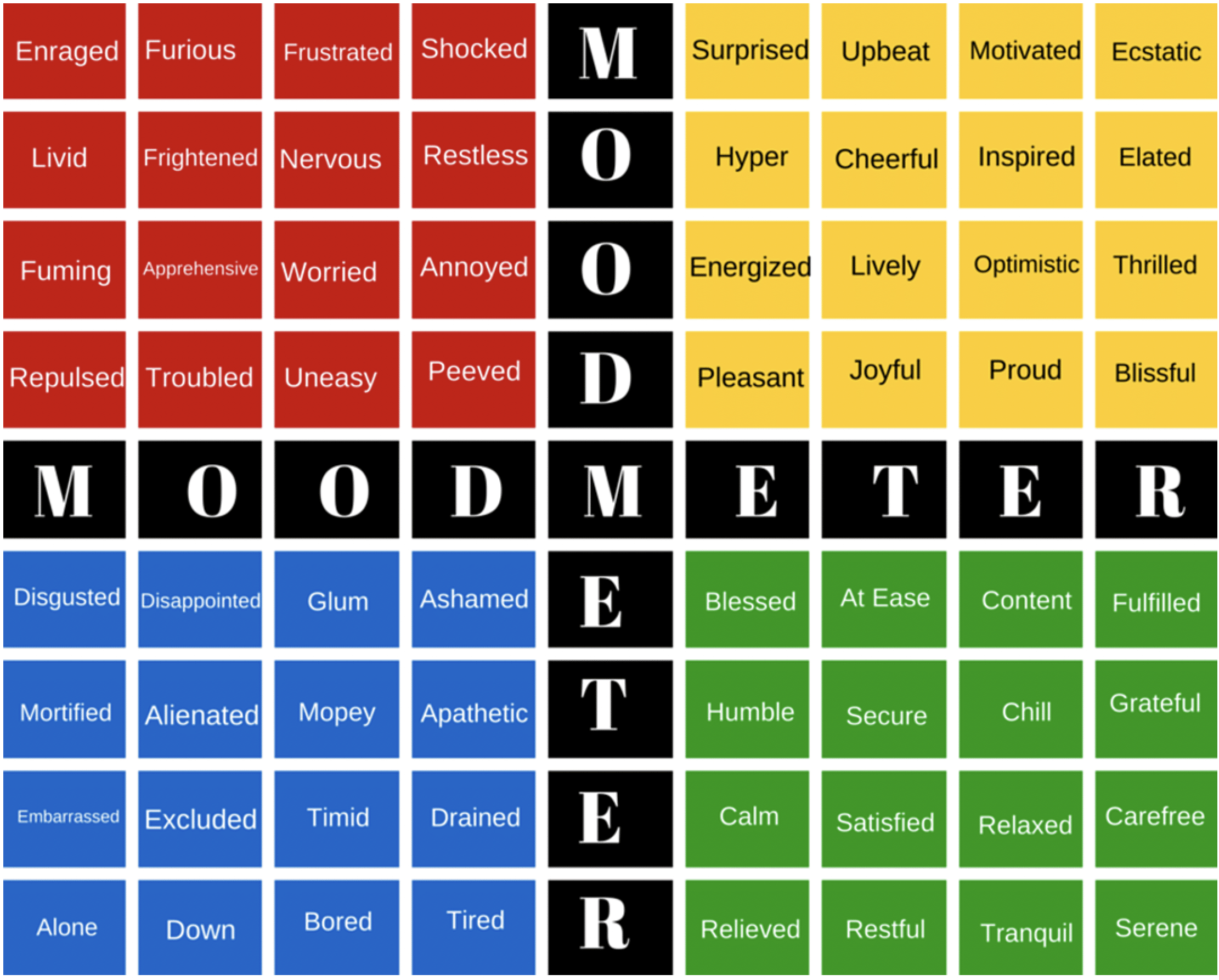
EMPATHY BUILDINGEach person chooses (or is assigned) an emotion and goes to the middle of the circle one at a time to act out the emotion. Students in the circle should raise their hands when they think they know the emotion and the actor gets to call on people to guess. The correct guesser goes next. Use Yale’s Mood Meter to practice with a variety of emotions!
YALE’S MOOD METER
Online Game Ideas
- Heart Drawing Partner Activity (video)
- Double This Double That – energizer (video)
- Catch a Brain Wave – energizer (video)
Appendix C — Guest Speakers
- Guest speakers should be philanthropists. This means you can cast a wide net for any students or professionals in your community who give back with their 3Ts – time, talent, or treasure, whether it is part of their job, school requirements, or they do it on their own time. Think about recruiting Project Heart graduates (older elementary, MS, or HS students), program staff, or teens doing internships with nonprofit organizations.
- The number one reason to recruit a diverse range of guest speakers (age, race, gender, etc.) is to provide students with real-life examples. The more trusted adults and “near peers” that our students can connect to, the more likely they are to build empathy and know that “if they can see it, they can be it”.
- Nonprofit organizations often have presentations prepared for when school visits are requested. Consider contacting nonprofits connected to your students’ interests. You can find contact information in Appendix D.
- Otter Products and other companies in Northern Colorado offer paid volunteer time off. These people are great resources because that means their company values philanthropy, too. If you are not directly in touch with the OtterCares Director of Programs and Partnerships, please contact Kelsey.
Interview Questions for Guests
- What community issues are you passionate about?
- What does philanthropy mean to you?
- What do you do as a philanthropist right now?
- How do you feel when you give your time, talent, or treasure in the community?
- What needs do you fill or what problems do you solve?
- What was your first activity ever as a philanthropist? How old were you?
- What do you like best about being a philanthropist?
- Generate more questions from student curiosity!
Appendix D — Project Ideas, Nonprofits & Financial Concerns
Most student projects fall into one of three categories:
Creation for Donation or Sale
This could look like making dog beds for the animal shelter, making friendship bracelets or stuffies for students who are sick in the hospital, creating illustrated books for seniors, etc. Creating something to sell is also very popular. Students like to make things like slime or duct tape creations with the intention of selling them and raising money for their nonprofit of choice.
An Event
This could look like hosting a dog wash and asking for donations, which would go to a preselected animal agency; hosting a party where students teach others about the need they identified and ask people to help support the organization; putting on a performance and asking for donations for the nonprofit; etc.
A Drive
Students could collect food, clothes, toiletries, or numerous other helpful items. Typically, you would choose a nonprofit with a need first and then research to find out what they need.
These projects tend to work best — but it’s also good to let students fail. Steer them toward success, but if students are passionate about a decision and everyone will be physically safe, let them try, fail, and figure out what to change. The most successful humans have lots of practice with failure — and sometimes the students succeed even when we’re skeptical!
NEED INSPIRATION
Check out our Project Ideas page for real student project ideas organized by cause — animals, food, homelessness, and more.
Financial Concerns
Week 3 is a great time to evaluate what kind of support your students will need. If you can see that your students are heading in an entrepreneurial direction, then they will likely need money for supplies. Or maybe supplies are readily available, but they will want to seek matching dollars for a fundraiser. This is a great time to start thinking about having the students apply for the OtterCares Illumination Fund. Regardless, it is important to start identifying any and all financial needs so you can better ensure project success! This is another great opportunity for students to take ownership, research the financial needs themselves, and practice grant writing.
Brainstorming — Support for Lessons 3 and 4
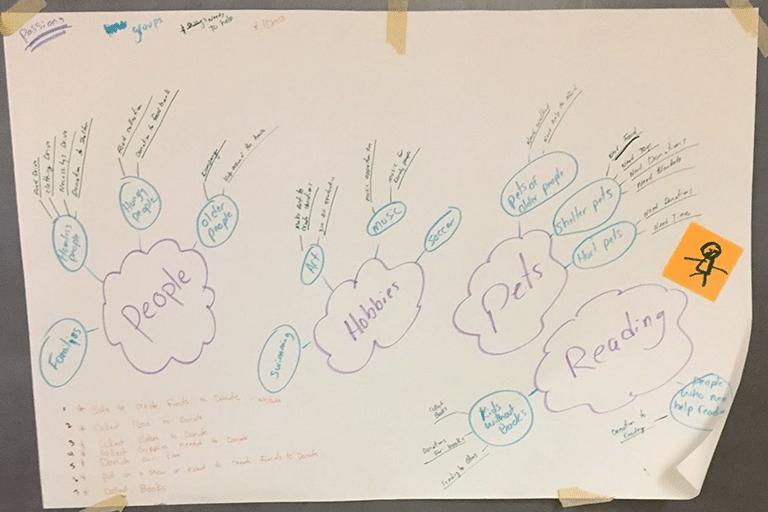
There are many ways to brainstorm and then come to consensus as a group! The first image is a mind map from a large after-school club with big idea categories to represent some of their passions. They slowly narrowed down and agreed on three separate goals for three small groups.
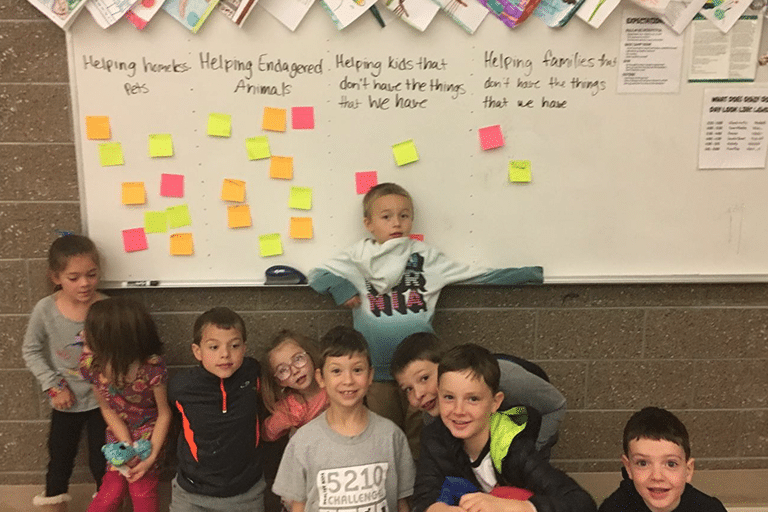
To the right is a consensogram from a small after-school group. They narrowed down the top four big idea categories they were passionate about, wrote them on the board, and then each student got two sticky notes to mark their top two choices. The whole group agreed on the category with the most sticky notes.
Appendix E — Rubric, SMART Goals, Letters Home & Planners
Rubric — Project Heart for Club or Camp: How Did We Do?
| Category | 4 | 3 | 2 | 1 |
|---|---|---|---|---|
| Empathize | Students fully empathized with the people (or animals) by thoroughly researching their need(s) and understanding what they must feel like. | Students mostly empathized with the people (or animals) by researching their need(s) and trying to understand what they must feel like. | Students attempted to empathize with the people (or animals) by thinking about their need(s). | Little attempt was made to empathize with the people (or animals) by thinking about their need(s). |
| Define | Students identified personal passions, matched with a need in our community, and decided on a solution that included everyone in the group. | Students focused on a need in our community and decided on a solution that mostly included everyone in the group. | Students decided on a solution that mostly met a need in the community. Some of the group was included. | It is unclear whether personal passions were connected to a need, and few group members participated in the solution. |
| Ideate | Students brainstormed many creative solutions to meet a need and effortlessly included everyone in the group when deciding on the final solution. | Students brainstormed some solutions to meet a need and mostly included everyone in the group when deciding on the final solution. | Some students decided on solutions to meet a need and tried to include everyone in the group for the final decision. | Only 1 or 2 students decided on solutions to meet a need, and there was little effort to include everyone in the group. |
| Prototype | Students decided on a solution by honoring all group ideas and failed forward until the final outcome. | Students tried to decide on a solution by honoring all group ideas and failed at least once before the final outcome. | Some students tried to decide on a solution with only their ideas and failed at least once before the final outcome. | Only 1 or 2 students tried to decide on a solution, then mostly failed at achieving an outcome. |
| Test & Share | Students connected to personal passions, then researched and/or interviewed users to determine if the solution met the identified needs. | Students researched and/or interviewed users to determine if the solution met the identified needs. | Students researched a little about whether or not the solution met the identified needs. | Little attempt was made to determine whether or not the solution met the identified needs. |
SMART Goals Reference
| Specific | Specific means your goal is detailed and clearly answers the questions who, what, where, when, why, and which. |
| Measurable | Measurable means you can track your progress and know when your goal is met, usually involving numbers. |
| Attainable | Attainable means your goal is realistic. It’s not too easy or too far out of reach. |
| Relevant | Relevant means your goal actually means something to you and meets a real need. |
| Timely | Timely means your goal will be accomplished in the set timeframe, within a few weeks for your Project Heart. |
You may have more than one goal, but they should all be SMART. Prioritize no more than four goals at a time, and use them to determine your actions. Here is an example:
I want to ______________________ by ______________, so I will ______________________ to meet my goal.
Project Planning Templates & Letter Home
Project Tracker for Whole Group
Week-by-week planner walking the full group through Empathize, Define, Ideate, Prototype, and Test.
Project Tracker for Small Action Teams
Team-level tracker for names, big ideas, materials, weekly to-dos, and how it went.
Prep Week Letter about Project Heart
Prep Week letter home introducing Project Heart to families, with a student-parent interaction activity.